

Global EV Battery Technology Market Set to Reach USD 156.95 Billion by 2031, Up from USD 98.65 Billion in 2025 – Arizton

Arizton Advisory and Intelligence
Consumer preference for passenger EVs is rising worldwide, with PHEVs favored in low-charging regions and stronger BEV adoption
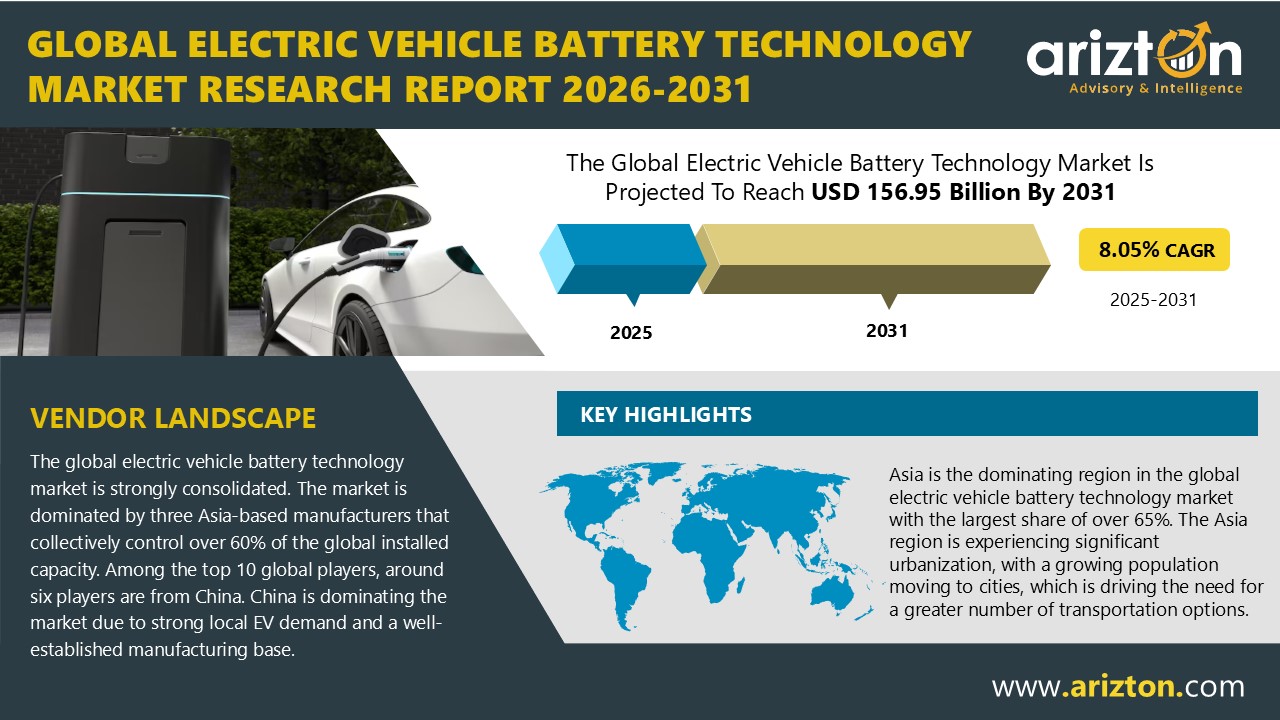
CHICAGO, IL, UNITED STATES, January 28, 2026 /EINPresswire.com/ -- The global electric vehicle battery technology market was valued at USD 98.65 billion in 2025 and is projected to reach USD 156.95 billion by 2031, growing at a CAGR of 8.05% as EV adoption accelerates worldwide, according to recent research by Arizton. Market growth is supported by zero-emission mandates, declining battery costs, and continuous technological innovation, while emerging trends such as sodium-ion batteries, solid-state battery development, and the rapid expansion of EV battery gigafactories are reshaping cost structures and global supply chains.
In-Depth Insights: https://www.arizton.com/market-reports/electric-vehicle-battery-technology-market
Report Summary:
MARKET SIZE (2031): USD 156.95 Billion
MARKET SIZE (2025): USD 98.65 Billion
CAGR (2025-2031): 8.05%
HISTORIC YEAR: 2022-2024
BASE YEAR: 2025
FORECAST YEAR: 2026-2031
MARKET SEGMENTATION: Battery Technology, Vehicle Type, Passenger EV and Geography
GEOGRAPHIC ANALYSIS: Asia, Europe, North America, and Rest of the World
EV Battery Gigafactories Emerge as a Strategic Growth Driver
The rapid expansion of EV battery gigafactories worldwide is a defining trend in the global electric vehicle battery market, driven by the need for cost reduction, supply security, and large-scale manufacturing efficiency. As automakers and battery manufacturers seek to secure volumes, meet localization and policy mandates, and reduce logistics complexity, investments in gigafactory capacity are accelerating across key regions. These facilities, designed to produce battery cells and packs at gigawatt-hour scale, enable technological scaling and remain the most effective pathway to lowering cost per kWh. To guarantee long-term supply, OEMs are increasingly forming joint ventures or developing in-house gigafactories, reinforcing the sector’s capital-intensive growth trajectory.
Recent Developments in the Electric Vehicle Battery Technology Market
• In November 2024, CATL and Stellantis collaborated on a new $4.3 billion electric vehicle (EV) battery plant in Spain through a joint venture, with construction commencing in late 2025. It will create more than 4,000 direct jobs and thousands of indirect jobs.
• In April 2025, the company announced a partnership with Harbinger for’s medium-duty electric vehicles for supplying batteries.
• In November 2025, LG Energy Solutions and the US-based automotive technology and vehicle manufacturer Rivian signed a 5-year supply agreement for 46-Series Batteries.
LFP Battery Segment Dominates the EV Battery Market with 53% Share
The Lithium-Iron Phosphate (LFP) segment leads the global EV battery market with around 53% share, driven by its strong thermal stability, long cycle life, and cost efficiency. Lower fire risk compared to nickel-based chemistries makes LFP batteries ideal for high-utilization applications such as electric buses, taxis, and commercial fleets, while their simpler chemistry supports large-scale production. Low total cost of ownership and predictable replacement cycles continue to boost demand, alongside growing industry interest in sodium-ion batteries as a complementary, cost-focused EV technology.
Sodium-Ion Batteries Move from Concept to Commercial Opportunity
Sodium-ion batteries are emerging as a major trend in the EV and energy storage technology as OEMs and cell manufacturers increasingly seek cost-efficient and supply-resilient alternatives to lithium-ion systems. Supported by abundant raw materials and lower production costs, this chemistry helps reduce exposure to lithium supply-chain concentration and price volatility, while enabling broader battery-chemistry diversification. In parallel, sodium-ion batteries deliver strong cold-weather performance, enhanced safety with lower thermal-runaway risk compared to LFP and NCM chemistries, and simplified logistics through zero-volt transport. Collectively, these advantages position sodium-ion batteries as a practical and scalable solution for selected EV and stationary storage segments, strengthening their role in the evolving global battery landscape.
Asia Anchors the Global EV Battery Technology Market
Asia dominates the global electric vehicle battery technology market with a share of over 65%, supported by rapid urbanization, rising city populations, and accelerating demand for affordable and scalable transportation solutions. This structural shift is driving strong EV adoption across the region, translating into sustained demand for battery technologies. Lithium-Iron Phosphate (LFP) remains the preferred chemistry in Asia due to its cost competitiveness and suitability for mass-market EVs, with leading manufacturers such as CATL and BYD deploying LFP batteries extensively for both domestic consumption and export markets. In contrast, NMC and NCA batteries are primarily positioned in premium and long-range vehicle segments, supported by strong export demand from North American and European markets
Looking for More Information? Click: https://www.arizton.com/market-reports/electric-vehicle-battery-technology-market
Key Vendors
• BYD
• CATL
• LG Energy Solutions
• Panasonic
• Samsung SDI
Other Prominent Vendors
• CALB
• EnerSys
• Envision AESC
• EVE Energy Co., Ltd.
• Farasis Energy
• Gotion High-Tech
• Lyten, Inc.
• SK Corp.
• Sunwoda
• SVOLT Energy
• Tesla
• Toshiba Corporation
• A123 Systems Corp.
• Amara Raja Batteries
• Exide Industries Ltd.
• Microvast Holdings, Inc.
• Neuron Energy
• ProLogium Technology CO., Ltd.
• QuantumScape Battery, Inc.
The Electric Vehicle Battery Technology Market Size, Share, & Trends Analysis Report By
• Battery Technology: Lithium Iron Phosphate (LFP), Nickel Manganese Cobalt (NMC), and Others
• Vehicle Type: Passenger EV, Light-Duty EV, and Commercial EV
• Passenger EV: Battery Electric Vehicle (BEV) and Plug-in Hybrid Electric Vehicle (PHEV)
• Geography: Asia, Europe, North America, and the Rest of the World
Related Reports That May Align with Your Business Needs
Electric Vehicle Battery Recycling Market - Global Outlook & Forecast 2023-2028
https://www.arizton.com/market-reports/electric-vehicle-battery-recycling-market
U.S. Electric Vehicle Fluids Market - Industry Outlook & Forecast 2022-2027
https://www.arizton.com/market-reports/us-electric-vehicle-fluids-market
What Key Findings Will Our Research Analysis Reveal?
• Which region dominates the global electric vehicle battery technology market?
• How big is the global electric vehicle battery technology market?
• What is the growth rate of the global electric vehicle battery technology market?
• What are the key trends in the global electric vehicle battery technology market?
• Who are the major players in the global electric vehicle battery technology market?
Why Arizton?
100% Customer Satisfaction
24x7 availability – we are always there when you need us
200+ Fortune 500 Companies trust Arizton's report
80% of our reports are exclusive and first in the industry
100% more data and analysis
1500+ reports published till date
Post-Purchase Benefit
• 1hr of free analyst discussion
• 10% off on customization
About Us:
Founded in 2017, Arizton Advisory & Intelligence delivers data-driven market research and strategic consulting that empowers clients to make informed decisions and drive growth. Combining quantitative and qualitative insights, we provide in-depth analysis across industries including Agriculture, Consumer Goods, Technology, Automotive, Healthcare, Data Centers, and Logistics. Recognized by top-tier media, our expert team transforms complex market data into actionable strategies, helping clients anticipate trends, seize opportunities, and stay ahead of the competition.
Jessica
Arizton Advisory & Intelligence
+1 312-233-2770
jessica@arizton.com
Visit us on social media:
LinkedIn
Facebook
X
Legal Disclaimer:
EIN Presswire provides this news content "as is" without warranty of any kind. We do not accept any responsibility or liability for the accuracy, content, images, videos, licenses, completeness, legality, or reliability of the information contained in this article. If you have any complaints or copyright issues related to this article, kindly contact the author above.
